

























































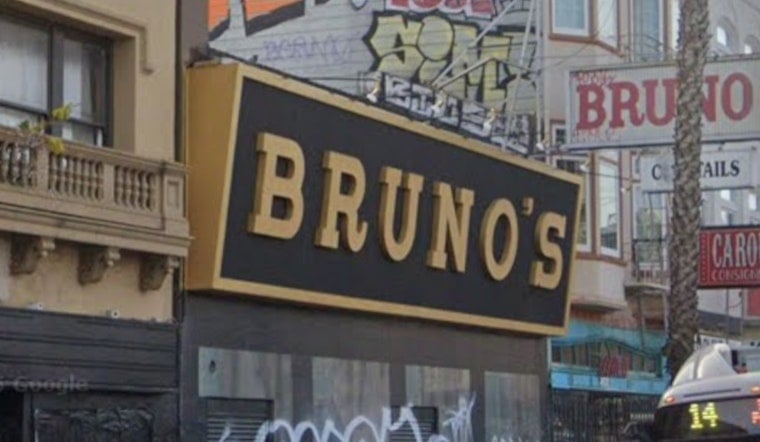
Bruno's, the Mission District nightclub that went dark in the early days of the COVID-19 pandemic lockdown, is set to reopen next Saturday, September 12, after a six-year closure. The venue at 2389 Mission Street will hold a soft opening featuring DJ REZA and DJ Ibarra, kicking off a month of weekend test-run events before a possible grand opening during the first weekend of October.
The long-awaited return, first detailed by Mission Local, comes after what the outlet reports was a reopening delayed by difficulties obtaining city permits. Bruno's has occupied the same Mission Street storefront for more than 60 years, evolving from an Italian restaurant and labor hangout into the nightclub generations of San Francisco know today. General manager Travis Blain told the outlet he was unsure why the opening had been delayed so long.
Six Years of Boarded-Up Blight on the Corridor
The building sat visibly abandoned for much of that stretch. Following its March 2020 closure, the storefront at 2389 Mission Street remained boarded up with plywood and covered in graffiti for nearly four years, according to The San Francisco Standard, becoming a visible emblem of blight along the corridor. George Karas was listed as Bruno's owner when a 2023 reopening report was first published, though the venue is now owned by Noelle Calixto, whose broader San Francisco hospitality portfolio also includes The Owl Tree in Lower Nob Hill, Chief Sullivan's in North Beach, and Campus, a bar in the Marina.
Calixto is no stranger to opening nightlife venues in the city. She previously partnered with restaurateur Rick Howard in 2015 to launch Russian Hill's House Rules and is also associated with Chief Sullivan's, a North Beach pub, according to Art and Entertain Me.
A Municipal Roadblock and a Statutory Workaround
Part of the challenge involved restrictions on alcohol licenses in the Mission. Bruno's had an improper restaurant license and could not obtain a new Type 48 license in the restricted district.
The path forward eventually ran through Sacramento rather than City Hall. In 2022, California enacted Senate Bill 793, establishing the Type 90 Music Venue License, which the state's Department of Alcoholic Beverage Control notes allows live performance facilities to sell alcohol without operating a full-service kitchen. Under Type 90 rules, alcohol service is limited to a window starting two hours before a live performance and concluding one hour after the show ends, per the agency's regulations.
City Hall Weighs In on the Corridor's Revival
Local elected officials also pushed the effort along. During a February 2024 Board of Supervisors meeting, the board passed a resolution recommending the state issue a new liquor license for Bruno's, and then-District 9 Supervisor Hillary Ronen publicly endorsed the measure, stating her office had actively worked to restore commercial safety and vibrancy along the Mission corridor, the Standard reported.
Bruno's history on Mission Street stretches back more than 60 years, with the venue occupying the same storefront for that time. The venue remains part of the Mission Street corridor today.
What Guests Can Expect Next Saturday
The new Bruno's is described as a nightlife spot, offering cocktails and focusing on local DJ talent. Blain says the goal is a hospitable neighborhood vibe rather than the standoffish energy found at many nightclubs, with front-door staff meant to be welcoming and security acting as hosts rather than bouncers.
The San Francisco Entertainment Commission's 2019 annual report also covers the city's nightlife sector.
“Guest experience is the first and most important thing,” Blain told Mission Local, adding that the neighborhood wants Bruno's operating again. The venue will remain a nightlife spot at its core, but the emphasis on approachability marks a deliberate shift for a corridor that spent six years staring at plywood and graffiti instead of a lit-up marquee.





